Grateful to give back
 After a 99-day stay at University Health (UH), which included more than 20 surgeries, you might assume that Marcus Smith would try to avoid hospitals from now on. But for the last three years Smith, a 30-year-old father of four, has been taking steps that no one expected.
On November 2, 2020, Smith’s life changed when he hopped on his motorcycle to head home from work. “I got run over by a dump truck. I remember that. And I was flashing in and out of consciousness underneath the truck, because I was pinned under the wheels,” said Smith.
“I got run over by a dump truck..."
Emergency crews rushed Smith to University Health, an American College of Surgeons Verified Level 1 Trauma Center, where the highly skilled emergency staff worked to save his life.
“It was scary, very scary,” recalls his wife, Kelsie, even though she didn’t know the details of how critically her husband was injured – or how close she came to having to raise their children alone.
| VIDEO: Watch how Marcus Smith uses his experience as a double amputee to inspire others who have undergone a serious injury. 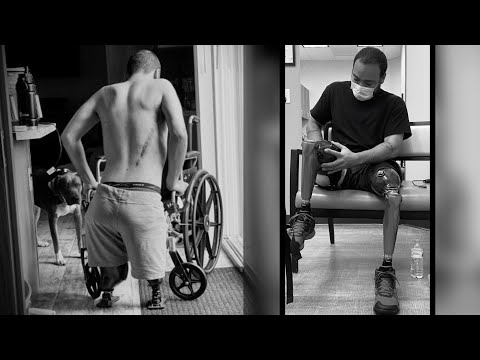
|
Marcus then began his 99-day stay at University Health, at a time when the COVID-19 pandemic was taking its toll on the world. To prevent the virus from spreading, Marcus was allowed just one visitor a day. It was almost always his wife. “The thing that sticks in my heart the most about Mr. and Mrs. Smith is that regardless of what the Smiths were facing with his health, their family was always the priority. They demonstrated love and devotion with every action and word,” said Brigid Toyne-Barfoot, D.N.P, an advanced care nurse overseeing the unit where Marcus spent the majority of time. “It was a true honor and lesson in unconditional love daily while caring for this family.”
“It was scary, very scary,” recalls his wife, Kelsie
“From the moment I woke up there was a smile on my face, and the smile was only able to be there because of the power our family has in it,” Marcus said. But that smile masked immeasurable physical pain, the trauma of losing his legs, the loneliness of missing his children and the stress of watching his wife try to raise those children on just a fraction of their usual monthly income as a semi-truck driver.
As the team of UH surgeons, nurses and physical therapists worked to help Marcus recover, the Smiths learned to find gratitude for each moment, whether it be picking up their children from school or a family beach vacation. “I think it’s made me better,” Marcus said. “Both of us,” agreed Kelsie. “We do more. He’s been skiing, and playing basketball, softball, football and golf. He’s even been on a horse,” she said. “He’s done a lot.”
Which gets us back to Marcus and why he’s been making extra visits to University Health. The doctors, nurses, therapists and techs who spent those 99 days with Marcus knew he had a remarkable gift, the ability to connect with struggling patients.
“I’ve walked into patients’ rooms where they’re in the worst pain of their life, and I understand that feeling. I know exactly what that feels like,” said Marcus. “It’s critical and essential that they see somebody who’s been through, and survived, similar things.”
So Marcus generously offers his time, his empathy. He visits members of his care team who “frequently reminded me that everything was going to be okay and they got me. They got us,” he said. Kelsie also credits Marcus’ care team with her survival. She calls theirs a reciprocal relationship of kindness and respect.
It’s been three years since that crash. In some ways it seems like a lifetime ago for the Smiths, but then again not, according to Marcus. “I kind of live in it a little bit, everyday life is kind of a testimony, you know?” he said. During those years Marcus coached a couple seasons of his sons’ football team, crediting the 4th and 5th grade Independence Hawks with pushing him physically, making him stronger.
Slowly but surely Marcus has been able to increase the height of his prosthetics, making him happy to once again be taller than his sons. Using prosthetics is tricky in a way most people never think about. Imagine walking without being able to feel the ground. Or having to use your core strength to lift your body onto prosthetic feet. “Marcus is a force of nature,” said orthopaedic trauma surgeon, Jonathan Dubin, M.D. “I certainly would not have the mental fortitude to overcome the adversity he faced from his trauma.”
On days that his physical strength is lacking, Marcus uses a wheelchair. His wife will tell you that even then, he always opens the door for her first.
The Smiths are grateful for each moment they have together, “I get to experience all the things that flashed through my mind [after the crash]. They almost slipped through my hands, so ever since I’ve been able to grab on and go,” Marcus said.
This Thanksgiving, the UH doctors and nurses, therapists and technicians responsible for saving Smith’s life are grateful for his visits, crediting him with adding to their resiliency to continue caring for patients.